
If you are still creating one page for one keyword, you are already behind.
Modern SEO in dubai is no longer about ranking for a single term. It’s about building topical authority — and keyword clustering is the foundation of that strategy.
Yet most businesses overcomplicate it.
They use complicated spreadsheets, expensive tools, and confusing systems. The result? They delay execution and never build real search momentum.
The truth is:
Keyword clustering can be simple, strategic, and extremely powerful — if you approach it the right way.
Let’s break it down.
What Is Keyword Clustering?
Keyword clustering is the process of grouping related search queries that share similar search intent into one structured content strategy.
Instead of creating 10 weak pages targeting similar keywords, you create:
One strong pillar page
Several supporting cluster pages
Internal links connecting them strategically
This structure signals to Google that your website has depth, authority, and expertise on the topic.
And Google rewards depth.
Why Keyword Clustering Matters More Than Ever
Google’s algorithm has evolved.
It no longer ranks pages based on exact keyword repetition. It ranks based on:
Context
Semantic relevance
Search intent
Topic authority
If you want to rank in competitive markets — especially in industries like SEO, medical, real estate, or finance — you must build topical clusters.
Without clustering, your content competes against itself.
With clustering, your content compounds authority.
The Biggest Mistake People Make
Most people:
Export 500 keywords
Sort them by volume
Create random blog posts
This creates keyword cannibalization.
Multiple pages target similar intent. Google gets confused. Rankings stay unstable.
Keyword clustering fixes this by organizing content around intent, not just keywords.
The Easy Way to Do Keyword Clustering (Step-by-Step)
Let’s simplify the process.
Step 1: Identify the Core Topic
Start with one primary topic.
Example:
“SEO Services”
“Medical Marketing”
“Real Estate in Dubai”
This becomes your pillar page.
The pillar page should target the main commercial keyword and provide broad coverage of the topic.
Step 2: Collect Related Keywords
Use tools like:
Google Search suggestions
People Also Ask
Related searches
Ahrefs
SEMrush
Google Search Console
Collect all relevant variations.
Example for “keyword clustering”:
keyword clustering strategy
keyword grouping method
SEO keyword clusters
content clustering for SEO
topic clusters SEO
how to group keywords
Don’t overthink this stage. Just gather.
Step 3: Group by Search Intent (Not Volume)
This is where most people fail.
Instead of grouping by similarity in wording, group by intent.
Ask:
If someone searches these two keywords, do they expect the same page?
If yes → Same cluster.
If no → Different cluster.
For example:
“How to do keyword clustering”
and
“Keyword clustering tutorial”
→ Same intent → Same page.
But:
“Best keyword clustering tools”
→ Different intent → Separate page.
Intent-based grouping is the secret.
Step 4: Define Your Pillar + Cluster Structure
Now organize your structure:
Pillar Page:
Comprehensive guide on keyword clustering.
Supporting Pages:
Best keyword clustering tools
Keyword clustering vs keyword grouping
Manual vs automated clustering
How clustering improves rankings
Each supporting article links back to the pillar.
The pillar links out to all cluster articles.
This creates a content ecosystem.
Step 5: Use Internal Linking Strategically
Internal links are not random.
They should:
Use natural anchor variations
Connect semantically related pages
Support authority flow
Guide users logically
This reinforces topic relevance.
Google sees a clear topical map.
Step 6: Optimize for Semantic Coverage
Don’t obsess over repeating the main keyword.
Instead:
Cover subtopics
Answer related questions
Include variations naturally
Address beginner + advanced angles
When your content answers the full topic spectrum, ranking becomes easier.
Manual vs Tool-Based Keyword Clustering
There are two main approaches.
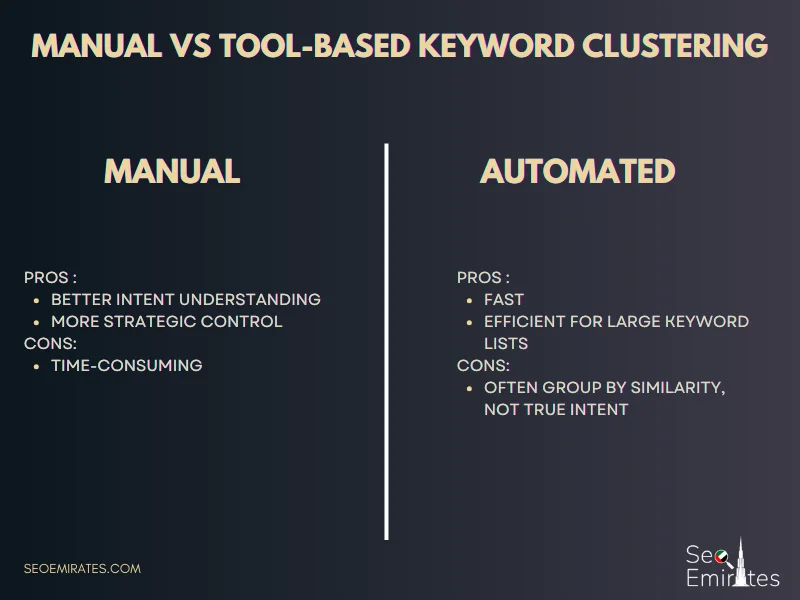
Manual Clustering
Pros:
Better intent understanding
More strategic control
Cons:
Time-consuming
Automated Clustering Tools
Pros:
Fast
Efficient for large keyword lists
Cons:
Often group by similarity, not true intent
Best approach?
Use tools for initial grouping.
Refine manually for intent precision.
How Keyword Clustering Improves Rankings
Here’s what happens when done correctly:
Reduced keyword cannibalization
Stronger topical authority
Higher dwell time
Better crawl efficiency
Improved internal link equity
Instead of competing with yourself, your pages support each other.
Authority compounds.
Real Example of Simple Clustering
Let’s say your main topic is:
Digital Marketing in Dubai
Cluster structure could be:
Pillar:
Complete Guide to Digital Marketing in Dubai
Clusters:
SEO in Dubai
PPC advertising Dubai
Social media marketing UAE
Content marketing strategy Dubai
Medical SEO in Dubai
Each page strengthens the main topic.
This structure works in competitive markets because it builds depth.
How Many Keywords Should Be in One Cluster?
There is no fixed number.
A cluster could contain:
5 closely related variations
Or 50 long-tail queries
What matters is intent alignment.
If they serve the same user need, they belong together.
Common Mistakes to Avoid
Creating separate pages for tiny keyword variations
Ignoring search intent
Forgetting internal linking
Targeting volume instead of relevance
Publishing thin content
Clustering only works when supported by strong content.
How Long Does It Take to See Results?
In competitive markets:
3–6 months for measurable growth.
6–12 months for strong authority.
Clustering accelerates ranking stability because Google recognizes structured expertise.
Final Thoughts
Keyword clustering is not complicated.
It becomes complicated when over-engineered.
The easy way is:
Define one core topic
Gather related queries
Group by intent
Build pillar + clusters
Link strategically
Cover the topic deeply
That’s it.
If you want scalable SEO growth — especially in competitive industries — keyword clustering is not optional.
It is foundational.
Build authority.
Structure your content.
Let your pages support each other.
That’s how modern SEO wins.